


Cerastium arcticum (now nigrescens) Arctic Mouse-ear R DDD N
Re-directed due to name change from Cerastium arcticum to Cerastium nigrescens var laxum.
The name for this species is changing in British floral lists and texts but not consistently. Work done on the Cerastium arcticum species growing in or near the arctic circle shows them to significantly different from the southerly species which grow in the British Isles. The proposal (see link below), accepted by Kent's lists and the BSBI lists but not yet the BSBI mapping data (at November 2008) is that our British species should be re-named Cerastium nigrescens.
This however is not a new name. Cerastium nigrescens was the systematic name for Shetland Mouse-ear so the new name suggests that there is no unique species growing Shetland - all Cerastium arcticum species including old Cerastium nigrescens in Shetland are now Arctic Mouse-ear and all are Cerastium nigrescens. So yet another plant (like Epipactis youngiana) has an action plan designed to save it when it no longer exists as a unique species.
See Trans-atlantic dispersal and phyleogeography of Cerastium arcticum (Caryphyllaceaea) inferred from RAPD and SCAR markers by R Hagen, H Giese and C Brochmann (March 2000) Link here
So our British plant is: C. nigrescens (H. C. Watson) Edmondston ex H. C. Watson (Brysting and Elven, 2000)
and the plant growing in the Arctic regions is C. arcticum sensu stricto (cf. Hultén, 1956)
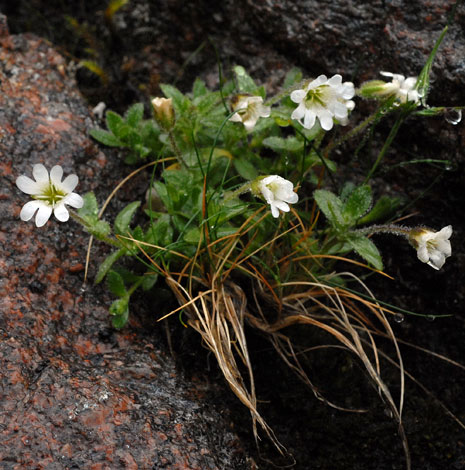
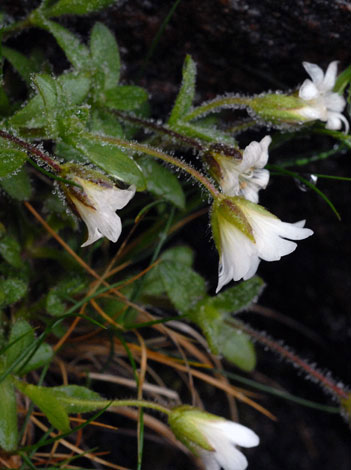
Cerastium nigrescens is much more difficult to separate morphologically from Cerastium alpinum (Alpine Mouse-ear) that I had thought. The flower is slightly reflexed in C. nigrescens but both are hairy with considerable variations possible in the hair features. The most convincing evidence is habitat. C. nigrescens is an acid rock species with C. alpinum usually a calciole. This specimen shown here is growing right out of the red granite of the Cairngorm on wet misty day when the visibility was only 30 or 40 metres. C. nigrescens has more glandular hairs supposedly but the "glands" you can see in the photo are actually drops of water.
Access for this specimen meant first driving to the highest car park in the land at the Cairngorm Ski lift centre then following the track towards the Northern Corries. This track has improved immeasurably since I last came with solid granite stones laid into the path for quite a distance. Eventually though you have to cross boulder fields and near the cliffs of Coire an t-Sneachda where this species lives, the small rocks and pebbles are all unstable. Two sticks were vital. If you have any doubts about this type of expedition then don't go.
It is found mostly in Scotland with just one outpost in Snowdonia (where I haven't been able to find it yet).
Coire an t-Sneachda, Cairngorms, Scotland 18th July 2007
Added on 20th Jul 07, updated 27th Nov 08, updated 12th Mar 10, re-directed updated Se3 30th Apr 10